Showing posts with label School. Show all posts

Thursday, August 8, 2013

Tangram Puzzle #1

Arrange the tans to make the shape below.  Tans cannot overlap.

FunForYoungAndOld.com
A Kite

To check the solution click the picture below.

Wednesday, August 7, 2013

Tangrams

Tangram is a Chinese dissection puzzle which uses 7 geometric shapes called "tans".  The seven shapes are: 2 large triangles, 2 small triangles, 1 medium triangle, 1 small square and 1 parallelogram.


The objective of the puzzle is to make a given shape with all seven tans without overlapping them.  You can enjoy the game of tangrams alone or with a friend.

A Bit Of Tangram History

The first book of tangrams was published in China in 1913 and by 1818 tangrams were popularized all over Europe.
It is unclear when the tangrams originated.  There are few versions of the origin of the name:
1.   Some believe they were created during the Tang Dynasty which was ruling China in 618 A.D. to 907 A.D.
2.   There is a story about man named Tan who supposedly dropped ceramic tile and by trying to put it together came up with the idea of a puzzle,
3.   There is believe that name came from an old English word "trangam", which means "puzzle" or "trinket",
4.   There is also theory that Tangrams are named after Tanka people who lived in southern China and Hong Kong.

To find out more check out book by Colleen Adams, Tangram Puzzles: Describing and Comparing Attributes of Plane Geometric Shapes.


Tangram Puzzle #1 A Kite
Tangram Puzzle #2 A Dog
Tangram Puzzle #3 A Relaxing Cat
Tangram Puzzle #4 A Bat
Tangram Puzzle #5 A Horse Playing Soccer
Tangram Puzzle #6 A Circus Seal
Tangram Puzzle #7 A Christmas Tree
Tangram Puzzle #8 A Steam Boat
Tangram Puzzle #9 A Curious Turtle
Tangram Puzzle #10 A Flying Bee
Tangram Puzzle #11 A Scarecrow


How To Make Tangram Puzzle

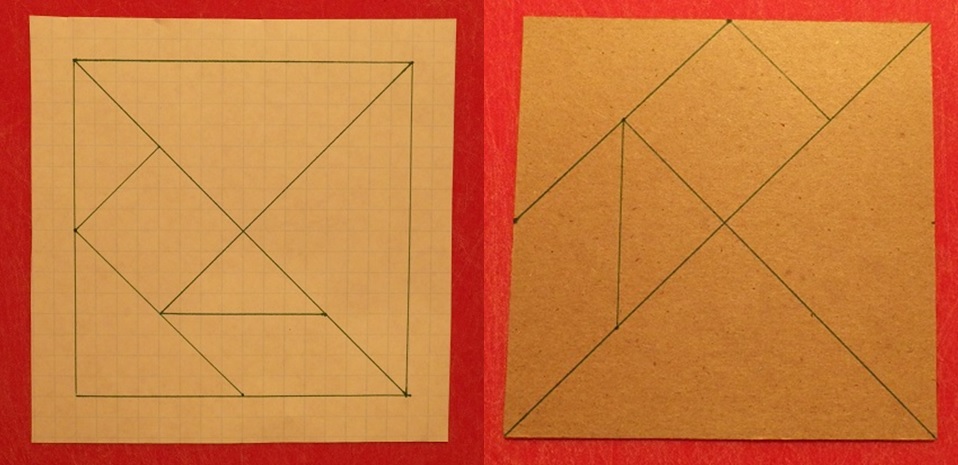
To make your own tangram puzzle you will need:  pair of scissors, cutting knife, square piece of cardboard (up to you how big you want it, though 4"x4" would be easier for you to measure), graph paper (optional), pen or pencil, and ruler.


You can use graph paper to make it easier to draw the lines to cut, or you can draw the lines directly on your cardboard.


How to draw the lines:
1. draw diagonal to get two big triangles 2. draw line connecting middle points of the sides of one of the triangles 3. draw another diagonal, but stop at the little triangle hypotenuse 4. draw line parallel to diagonal to create little square 5. draw line parallel to the side to create parallelogram.  You are done.  Now you can cut on the lines. 


You can color your tans.


Now you are ready to play.  Have fun.

Friday, July 26, 2013

Body Parts

How well do you know body parts?
FunForYoungAndOld.com

Can you list 10 body parts that are spelled with only three letters?

To check your answer click on the picture.

Wednesday, July 24, 2013

Home Made Slime

How to make your own, non-toxic slime?
You will need: 1.5 cups of water, Borax, non-toxic clear glue, food colouring, tea spoon and two bowls or pots.

Add a tea spoon of Borax to one cup of water, mix till the Borax dissolves completely,

Add glue to half a cup of water,

Add 5 drops of green and 2 drops of yellow food colouring to the water and glue mixture,

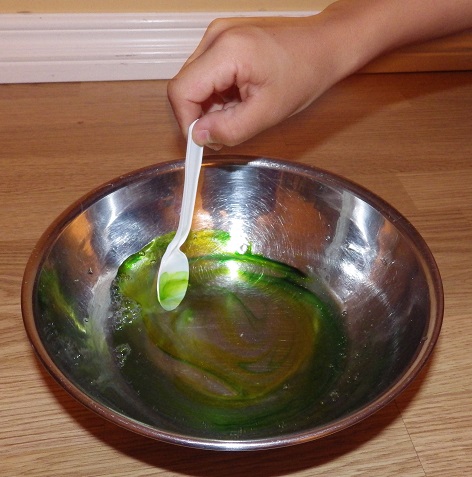
Stir to mix the two colours,

Add Borax and water mixture,

Stir till it becomes thicker,

Here is the slime. You can dispose of extra liquid.

Have fun playing with your slime.

Store it in a plastic bag and keep it away from sunny places so it will not dry out.
Caution: if your slime is too sticky, just add a bit more water and borax mixture, then dispose of extra liquid.
The slime should not stick to your fingers.

Tuesday, July 23, 2013

The Dragon's Scales

Great story by Sarah Albee, about a dragon who does not want to share, a little girl who saves a day, and a set of scales.


Holly outsmarts the dragon with three tests: would two things weigh more than one thing?  Is it always the case that the bigger thing weighs more than the smaller thing?  Do two things that are the same in size must weigh the same?

Check out the story it is fun to read and kids will enjoy solving the tests.

Monday, July 22, 2013

Measuring Liquid

How do you measure 1 liter of water when you only have 2L and 5L measuring cups without scale?

FunForYoungAndOld.com

How about when you have 3L and 5L measuring cups and you need 4 liters of water?

FunForYoungAndOld.com

To check the answers click the corresponding picture.

Saturday, July 6, 2013

Magic Square Of Order 3

What is a magic square?
A magic square is an arrangement of numbers in a square grid, when sums of numbers in each row, in each column and in both diagonals are equal.

A magic square of order 3 means that you will be arranging numbers 1 through 9 in a 3x3 grid.
Sum of each row, each column and each diagonal must equal 15.

Try it out:


Wednesday, July 3, 2013

How Many Days In July?

Do you have a hard time to figure out how many days in each month.
There is a simple way to do it.

Make two fists in front of you.  Starting from the left, assign month to each knuckle and each space between the knuckles.
The months on the knuckles have 31 days (January, March, May, July, August, October and December).
 The months in spaces between the knuckles, have 30 days (April, June, September and November)
February is an exception. It has 28 days and during the leap year, 29 days.

How lucky, Summer months, July and August, have 31 days.  Hooray!

Wednesday, June 12, 2013

Roman Numerals Puzzles

A boy in Ancient Rome had a quiz.  He was so absent minded that he made a mistake in each of his equations.

When the teacher checked the quiz, he thought the boy was teasing him, since all of the equations could be corrected by moving just one of elements (I, V, X, L,C, D, M, ---).  See if you can correct the equations.  Forgot how to convert Roman Numerals?  Click here.

Roman Numerals Equation I

Roman Numerals Equation II

Roman Numerals Equation III

Roman Numerals Equation IV

Roman Numerals Equation V

Roman Numerals Equation VI


Thursday, June 6, 2013

Playing with Roman Numerals

In schools and everyday life we are using Arabic numerals, which have 10 digits: 0, 1, 2, 3, 4, 5, 6, 7, 8, and 9.  

Ancient Romans used letters from Latin alphabet to write numbers.   There are seven basic letters in Roman numerals: I, V, X, L, C, D, and M.   Each of the letters have certain value and by combining the letters together other numbers are created.


Roman                   Arabic 
I          1
V        5
X        10
L         50
C        100
D        500
M       1,000
How do we create the numbers?

When you write the letters together you add the values, except when the lower value proceeds the higher value. See examples below:

Roman numeral
Equivalent to
Something to keep in mind
I
1

Only I, X, C, and M
can be subtracted


I can only be subtracted from
V or X


X can only be subtracted from
L or C


C can only be subtracted from
D or M


Never subtract
V, L, and D


II
1+1=2
III
1+1+1=3
IV
5-1=4
VI
5+1=6
VII
5+1+1=7
VIII
5+1+1+1=8
IX
10-1=9
XI
10+1=11
XX
10+10=20
XXX
10+10+10=30
Xl
50-10=40
LX
50+10=60
XC
100-10=90
CXX
100+10+10=120
cXL
100+50-10=140
CC
100+100=200
CD
500-100=400
DC
500+100=600
DCC
500+100+100=700
CM
1,000-100=900
MC
1,000+100=1,100

Now the fun begins. Here are some cool examples:

DCCCLXXII
500 + 100 + 100 + 100 + 50 +10 + 10 + 1 + 1 = 872

CMLV
C before M, means 1,000 – 100 = 900,
L = 50
V = 5
900 + 50 + 5 = 955

XCIX 
X before C means 100 – 10 = 90
I before X means 10 – 1 = 9
90 + 9 = 99

How about going the other way:
994 = 900 + 90 + 4
900 = 1,000 – 100, lower value comes before higher: CM
90 = 100 – 10, lower before higher: XC
4 = 5 – 1, lower before higher: IV
CMXCIV

453 = 400 = 50 + 3
400 = 500 – 100, lower before higher: CD
50 = L
3 = III. 
CDLIII

1,640  = 1,000 + 600 + 40
1,000 = M
600 = 500 + 100, means DC
40 = 50 – 10, lower before higher:  XL
MDCXL

***
BIBLIOGRAPHY
Adler, David A., Fun With Roman Numerals, Holiday House, New York, 2008.